
MUTTONI (Masahiko Muto)
Biography
Born in 1956 in Yokohama, Kanagawa Prefecture. After studying oil painting at the Sokei Academy of Fine Art & Design, he shifted to three-dimensional formative art. Since the late 1980s, he has gone by the name “MUTTONI” and begun in earnest the creation of unique automated mechanical devices that combine mechanical automata with sound and lighting effects. Transcending the boundaries of mere “moving dolls,” he established a unique genre of expression called the “Karakuri Theater” (mechanical theater), where stories unfold like plays or movies inside a single box. His exhibitions have been held at museums and literary museums nationwide, including the Setagaya Literary Museum, and he continues to captivate a wide range of fans across generations. He currently resides in Kunitachi, Tokyo.
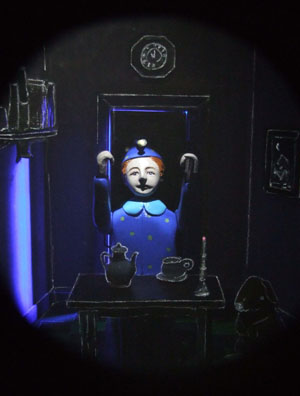
FIN, 2009
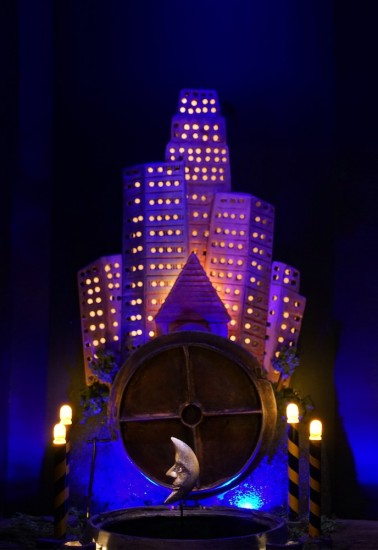
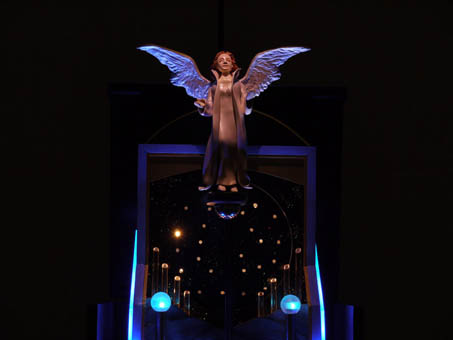
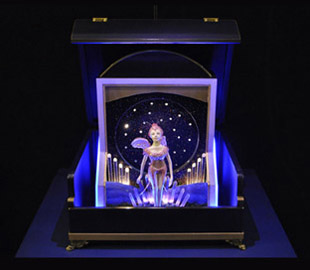
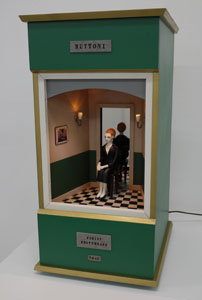
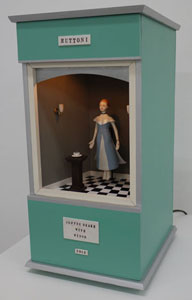
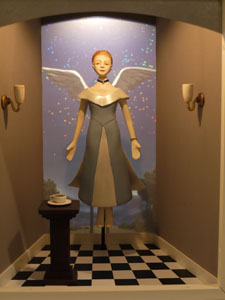
His works incorporate intricately crafted dolls, stage sets, motor-driven mechanisms, LED lighting, and sound systems for music and narration, all built into a wooden box. When activated, the dolls move smoothly in sync with highly calculated lighting and sound effects, creating a dramatic, densely packed theatrical space that unfolds before the viewer’s eyes for several minutes.
He is also highly acclaimed for a series of works based on masterpieces of modern and contemporary Japanese literature by authors such as Kenji Miyazawa, Sakutaro Hagiwara, and Atsushi Nakajima. Including works featuring original motifs such as angels and demons, city streets at night, and deserted bars, his art is characterized by a fantastical worldview that is somewhat nostalgic and melancholic, where the boundary between dream and reality blurs.
During exhibitions, MUTTONI is also known for holding “live performances” where he stands next to his works, often dressed in a tuxedo, and operates them while delivering a spoken narration (storytelling) in a distinctive tone. The physical movement of the works synchronizes with the narration by a live human being, creating a unique sense of immersion.
Exhibition History
(Kenji Taki Gallery / Gallery Kenbishi)
■ Solo Exhibitions
- 2001: Gallery Kenbishi (Nagoya)December 15–25, 2001: Automated Automata Maker Muttoni Exhibition Night Cap
- 2002: Gallery Kenbishi (Nagoya)November 16–30, 2002: MUTTONI Exhibition Night Elements
- 2003: Gallery Kenbishi (Nagoya)November 29–December 6, 2003: MUTTONI Exhibition PLAN OF MUTTONI
- 2007: Gallery Kenbishi (Nagoya)May 19–June 2, 2007: MUTTONI Exhibition PLANET THEATER OF MUTTONI
- 2008: Kenji Taki Gallery, Tokyo (Tokyo)July 10–August 8, 2008: MUTTONI Exhibition THE DIARY OF WINGS
- 2009: Kenji Taki Gallery (Nagoya)November 28–December 26, 2009: MUTTONI Exhibition TIME TRIANGLE
- 2011: Kenji Taki Gallery, Tokyo (Tokyo)February 3–March 3, 2011: MUTTONI New Works Exhibition WING ELEMENT
- 2013: Kenji Taki Gallery (Nagoya)January 26–March 2, 2013: MUTTONI Exhibition KIND OF NIGHT
- 2014: ART NAGOYA 2014 / Kenji Taki Gallery (The Westin Nagoya Castle, Nagoya)MUTTONI – Hotel Interior
- 2015: ART NAGOYA 2015 / Kenji Taki Gallery (The Westin Nagoya Castle, Nagoya)MUTTONI – Night Cap in the Hotel Room
- 2016: ART NAGOYA 2015 / Kenji Taki Gallery (The Westin Nagoya Castle, Nagoya)MUTTONI – Hall Clock Night
■ Group Exhibitions
- 2009: NINE, Kenji Taki Gallery, Tokyo
■ Art Fairs (Exhibited by Kenji Taki Gallery)
- 2008: Art Fair Tokyo (Tokyo International Forum Exhibition Hall, Tokyo)
- 2008: Asia Top Gallery Hotel Art Fair 2008 (Hotel New Otani, Tokyo)
- 2009: ART@AGNES 2009 (The Agnes Hotel and Apartments, Tokyo)
- 2009: Art Fair Tokyo (Tokyo International Forum Exhibition Hall, Tokyo)
- 2010: Art Fair Tokyo (Tokyo International Forum Exhibition Hall, Tokyo)
- 2011: ART OSAKA (Hotel Granvia Osaka, Osaka)
- 2011: ART NAGOYA (The Westin Nagoya Castle, Nagoya)
- 2012: ART KYOTO (Kyoto International Conference Center Annex Hall, Kyoto)
- 2012: ART OSAKA (Hotel Granvia Osaka, Osaka)
- 2012: ART NAGOYA (The Westin Nagoya Castle, Nagoya)
Public Collections & Permanent Exhibitions
- Setagaya Literary Museum, Tokyo (Multiple works are on permanent display as “Muttoni’s Karakuri Theater”)
- Hachioji Yume Art Museum, Tokyo
- Karuizawa Kogen Bunko, Nagano
- Maebashi Museum of Literature, Gunma
- Kitakyushu Museum of Literature, Fukuoka (among others)